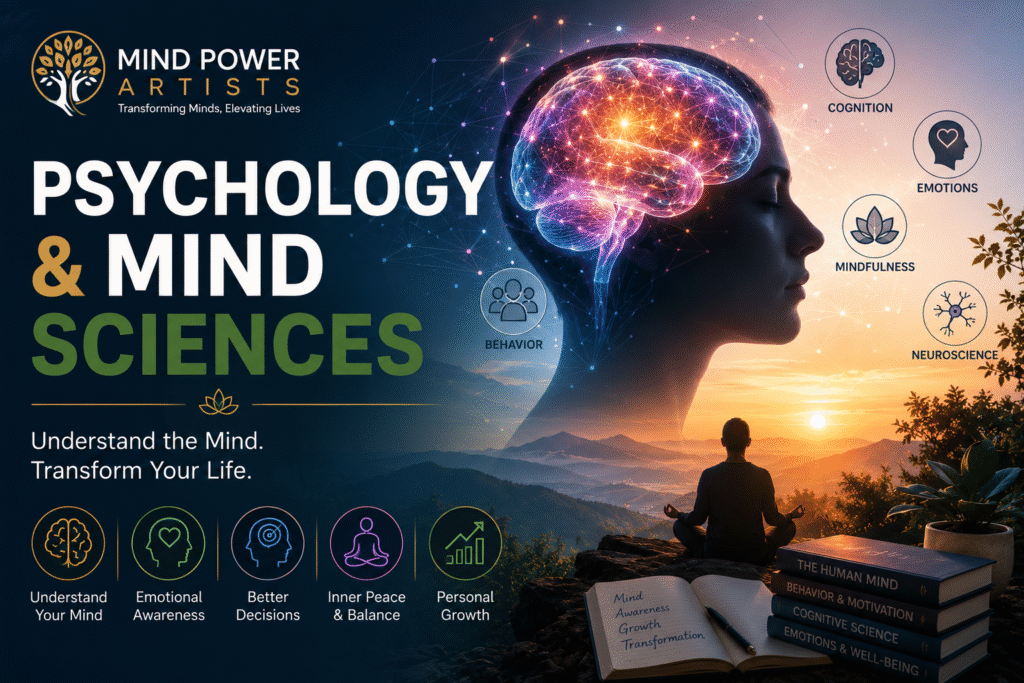
The human mind influences how we think, feel, learn, remember, make decisions, and respond to the world around us. Understanding the mind can therefore help us better understand ourselves, our behavior, and the patterns that shape our everyday lives.
Psychology & Mind Sciences explore these fascinating aspects of human experience. Psychology is broadly defined as the scientific study of the mind and behavior, with research covering areas such as cognition, emotions, motivation, personality, development, and social behavior.
At Mind Power Artists, we believe that developing awareness of the mind can be an important part of personal growth and transformation.
What Are Psychology & Mind Sciences?
Psychology is a scientific discipline focused on understanding mental processes and behavior. Psychological science uses research, observation, experimentation, testing, and analysis to explore how people think, feel, learn, and behave.
The broader field of mind sciences can include areas that help us understand different dimensions of the human mind, including:
- Cognitive psychology
- Behavioral science
- Neuroscience
- Emotional processes
- Learning and memory
- Motivation
- Personality
- Social psychology
- Human development
- Mindfulness and mental awareness
These areas provide different perspectives on the complex relationship between our thoughts, emotions, brain processes, behavior, and environment.
Why Understanding the Mind Matters
Every day, we make countless decisions based on our thoughts, experiences, emotions, beliefs, and perceptions.
Understanding these processes can help us become more aware of why we think and behave the way we do.
For example, you might notice that you:
- Overthink important decisions
- Lose confidence when facing challenges
- Repeat certain habits
- Struggle to maintain focus
- React emotionally to particular situations
- Have difficulty changing established patterns
- Feel motivated in some situations but not others
Exploring the psychology behind these experiences can provide greater self-awareness.
The Connection Between Thoughts, Emotions, and Behavior
One of the fascinating areas of psychology is the relationship between our thoughts, emotions, and behavior.
A situation can trigger a thought. That thought can influence an emotional response, which may then affect how we behave.
For example:
Situation → Thought → Emotion → Behavior
Imagine someone receives criticism at work.
One person may think:
“This is an opportunity to improve.”
Another person may think:
“I’m not good enough.”
The same situation can produce very different emotional and behavioral responses depending on how it is interpreted.
Understanding these patterns can help individuals become more conscious of their reactions and develop healthier ways of responding.
Cognitive Psychology and the Human Mind
Cognitive psychology focuses on mental processes such as thinking, learning, memory, attention, perception, and decision-making.
Cognitive psychologists study how people acquire, process, and store information and how cognition interacts with emotions.
This field can help us understand questions such as:
- How do we learn new information?
- Why do we remember some experiences more strongly than others?
- How does attention influence performance?
- Why do people make certain decisions?
- How do beliefs influence perception?
- How do emotions affect thinking?
Learning about these processes can help us become more aware of the way our minds operate.
The Role of Mind Sciences in Personal Development
Psychology is not only about understanding problems. Psychological science is also applied to areas such as education, health, workplace performance, relationships, and personal development.
Knowledge about the mind can support personal growth by helping individuals develop:
Self-Awareness
Understanding your thoughts, emotions, habits, strengths, and behavioral patterns can be the first step toward intentional change.
Focus and Attention
Learning how attention works can help people become more conscious of distractions and develop better strategies for maintaining focus.
Emotional Awareness
Recognizing emotions and understanding their triggers can improve the way we respond to challenging situations.
Learning and Growth
Understanding how learning and memory work can encourage more effective approaches to acquiring new skills and knowledge.
Resilience
Psychological knowledge can also contribute to developing resilience and adapting to life’s challenges.
Psychology, Mindset, and Personal Transformation
Our mindset influences how we interpret experiences and approach challenges.
A fixed mindset may cause someone to see abilities as unchangeable, while a growth-oriented perspective can encourage learning and continued development.
This does not mean simply thinking positively. Meaningful personal growth involves developing awareness, learning new skills, challenging unhelpful assumptions, and consistently applying constructive behaviors.
At Mind Power Artists, we combine personal-development practices with an interest in mind sciences to encourage individuals to explore their thoughts, beliefs, emotions, and inner patterns.
Psychology and the Subconscious Mind
The idea of the subconscious mind has fascinated researchers, philosophers, and personal-development practitioners for many years.
People often operate through learned habits and automatic responses without consciously thinking through every action.
For personal development, exploring these automatic patterns can encourage greater self-awareness.
Techniques such as mindfulness, meditation, reflective practices, and—where appropriate—hypnotherapy may be used as complementary approaches for exploring habits, thoughts, and personal patterns.
These approaches should not be considered substitutes for professional medical or mental-health care when such care is needed.
Psychology & Mind Sciences in Everyday Life
You do not need to be a psychologist or scientist to benefit from learning about the mind.
Psychology can be relevant to everyday situations such as:
Communication: Understanding how people perceive and respond to messages.
Relationships: Becoming more aware of emotions, expectations, and behavioral patterns.
Work: Understanding motivation, attention, decision-making, and performance.
Learning: Applying knowledge about memory, attention, and learning processes.
Personal Growth: Identifying habits and beliefs that may influence your actions.
The more we understand about ourselves, the more intentionally we can approach our decisions and personal development.
Exploring the Mind Through Mind Power Artists
At Mind Power Artists, our work focuses on personal transformation through an integrated interest in mind sciences, emotional wellness, subconscious-focused practices, meditation, spiritual growth, and personal development.
Guided by Sufi Awaisi, Mind Power Artists provides resources, courses, and sessions designed to help individuals explore their minds and develop greater self-awareness.
Our approach encourages people to look beyond surface-level habits and ask deeper questions:
- What beliefs influence my decisions?
- Why do certain patterns keep repeating?
- How can I become more aware of my thoughts?
- What habits support the person I want to become?
- How can I develop greater mental clarity and self-awareness?
Begin Your Journey of Understanding
The human mind is one of the most complex aspects of human experience. Psychology and related mind sciences continue to provide valuable insights into cognition, emotions, behavior, learning, motivation, and human development.
Understanding these subjects can help us become more curious about ourselves and more intentional about personal growth.
Your mind shapes much of how you experience the world. Understanding it can be the beginning of understanding yourself.
Explore Psychology & Mind Sciences and discover new perspectives on the mind, behavior, personal development, and human potential.
Frequently Asked Questions
What are Psychology & Mind Sciences?
Psychology is the scientific study of the mind and behavior. Mind sciences can broadly refer to related areas of study that explore mental processes, cognition, emotions, behavior, and the relationship between the mind and brain.
Why is psychology important?
Psychology helps us understand human thoughts, emotions, learning, behavior, motivation, and social interactions. Psychological science can also be applied to areas such as education, health, work, and personal development.
What is cognitive psychology?
Cognitive psychology is an area of psychology that studies mental processes such as thinking, memory, learning, attention, perception, and decision-making.
Can psychology help with personal development?
Psychological knowledge can support self-awareness, learning, resilience, performance, and understanding behavioral patterns. Personal development should be approached realistically and should not replace professional care when someone needs medical or mental-health support.
How can I learn more about my mind?
Reading about psychology, practicing self-reflection, developing mindfulness, learning about cognitive and behavioral patterns, and seeking qualified professional guidance when appropriate can all contribute to greater understanding of the mind.
The human mind influences how we think, feel, learn, remember, make decisions, and respond to the world around us. Understanding the mind can therefore help us better understand ourselves, our behavior, and the patterns that shape our everyday lives.
Psychology & Mind Sciences explore these fascinating aspects of human experience. Psychology is broadly defined as the scientific study of the mind and behavior, with research covering areas such as cognition, emotions, motivation, personality, development, and social behavior.
At Mind Power Artists, we believe that developing awareness of the mind can be an important part of personal growth and transformation.
What Are Psychology & Mind Sciences?
Psychology is a scientific discipline focused on understanding mental processes and behavior. Psychological science uses research, observation, experimentation, testing, and analysis to explore how people think, feel, learn, and behave.
The broader field of mind sciences can include areas that help us understand different dimensions of the human mind, including:
- Cognitive psychology
- Behavioral science
- Neuroscience
- Emotional processes
- Learning and memory
- Motivation
- Personality
- Social psychology
- Human development
- Mindfulness and mental awareness
These areas provide different perspectives on the complex relationship between our thoughts, emotions, brain processes, behavior, and environment.
Why Understanding the Mind Matters
Every day, we make countless decisions based on our thoughts, experiences, emotions, beliefs, and perceptions.
Understanding these processes can help us become more aware of why we think and behave the way we do.
For example, you might notice that you:
- Overthink important decisions
- Lose confidence when facing challenges
- Repeat certain habits
- Struggle to maintain focus
- React emotionally to particular situations
- Have difficulty changing established patterns
- Feel motivated in some situations but not others
Exploring the psychology behind these experiences can provide greater self-awareness.
The Connection Between Thoughts, Emotions, and Behavior
One of the fascinating areas of psychology is the relationship between our thoughts, emotions, and behavior.
A situation can trigger a thought. That thought can influence an emotional response, which may then affect how we behave.
For example:
Situation → Thought → Emotion → Behavior
Imagine someone receives criticism at work.
One person may think:
“This is an opportunity to improve.”
Another person may think:
“I’m not good enough.”
The same situation can produce very different emotional and behavioral responses depending on how it is interpreted.
Understanding these patterns can help individuals become more conscious of their reactions and develop healthier ways of responding.
Cognitive Psychology and the Human Mind
Cognitive psychology focuses on mental processes such as thinking, learning, memory, attention, perception, and decision-making.
Cognitive psychologists study how people acquire, process, and store information and how cognition interacts with emotions.
This field can help us understand questions such as:
- How do we learn new information?
- Why do we remember some experiences more strongly than others?
- How does attention influence performance?
- Why do people make certain decisions?
- How do beliefs influence perception?
- How do emotions affect thinking?
Learning about these processes can help us become more aware of the way our minds operate.
The Role of Mind Sciences in Personal Development
Psychology is not only about understanding problems. Psychological science is also applied to areas such as education, health, workplace performance, relationships, and personal development.
Knowledge about the mind can support personal growth by helping individuals develop:
Self-Awareness
Understanding your thoughts, emotions, habits, strengths, and behavioral patterns can be the first step toward intentional change.
Focus and Attention
Learning how attention works can help people become more conscious of distractions and develop better strategies for maintaining focus.
Emotional Awareness
Recognizing emotions and understanding their triggers can improve the way we respond to challenging situations.
Learning and Growth
Understanding how learning and memory work can encourage more effective approaches to acquiring new skills and knowledge.
Resilience
Psychological knowledge can also contribute to developing resilience and adapting to life’s challenges.
Psychology, Mindset, and Personal Transformation
Our mindset influences how we interpret experiences and approach challenges.
A fixed mindset may cause someone to see abilities as unchangeable, while a growth-oriented perspective can encourage learning and continued development.
This does not mean simply thinking positively. Meaningful personal growth involves developing awareness, learning new skills, challenging unhelpful assumptions, and consistently applying constructive behaviors.
At Mind Power Artists, we combine personal-development practices with an interest in mind sciences to encourage individuals to explore their thoughts, beliefs, emotions, and inner patterns.
Psychology and the Subconscious Mind
The idea of the subconscious mind has fascinated researchers, philosophers, and personal-development practitioners for many years.
People often operate through learned habits and automatic responses without consciously thinking through every action.
For personal development, exploring these automatic patterns can encourage greater self-awareness.
Techniques such as mindfulness, meditation, reflective practices, and—where appropriate—hypnotherapy may be used as complementary approaches for exploring habits, thoughts, and personal patterns.
These approaches should not be considered substitutes for professional medical or mental-health care when such care is needed.
Psychology & Mind Sciences in Everyday Life
You do not need to be a psychologist or scientist to benefit from learning about the mind.
Psychology can be relevant to everyday situations such as:
Communication: Understanding how people perceive and respond to messages.
Relationships: Becoming more aware of emotions, expectations, and behavioral patterns.
Work: Understanding motivation, attention, decision-making, and performance.
Learning: Applying knowledge about memory, attention, and learning processes.
Personal Growth: Identifying habits and beliefs that may influence your actions.
The more we understand about ourselves, the more intentionally we can approach our decisions and personal development.
Exploring the Mind Through Mind Power Artists
At Mind Power Artists, our work focuses on personal transformation through an integrated interest in mind sciences, emotional wellness, subconscious-focused practices, meditation, spiritual growth, and personal development.
Guided by Sufi Awaisi, Mind Power Artists provides resources, courses, and sessions designed to help individuals explore their minds and develop greater self-awareness.
Our approach encourages people to look beyond surface-level habits and ask deeper questions:
- What beliefs influence my decisions?
- Why do certain patterns keep repeating?
- How can I become more aware of my thoughts?
- What habits support the person I want to become?
- How can I develop greater mental clarity and self-awareness?
Begin Your Journey of Understanding
The human mind is one of the most complex aspects of human experience. Psychology and related mind sciences continue to provide valuable insights into cognition, emotions, behavior, learning, motivation, and human development.
Understanding these subjects can help us become more curious about ourselves and more intentional about personal growth.
Your mind shapes much of how you experience the world. Understanding it can be the beginning of understanding yourself.
Explore Psychology & Mind Sciences and discover new perspectives on the mind, behavior, personal development, and human potential.
Frequently Asked Questions
What are Psychology & Mind Sciences?
Psychology is the scientific study of the mind and behavior. Mind sciences can broadly refer to related areas of study that explore mental processes, cognition, emotions, behavior, and the relationship between the mind and brain.
Why is psychology important?
Psychology helps us understand human thoughts, emotions, learning, behavior, motivation, and social interactions. Psychological science can also be applied to areas such as education, health, work, and personal development.
What is cognitive psychology?
Cognitive psychology is an area of psychology that studies mental processes such as thinking, memory, learning, attention, perception, and decision-making.
Can psychology help with personal development?
Psychological knowledge can support self-awareness, learning, resilience, performance, and understanding behavioral patterns. Personal development should be approached realistically and should not replace professional care when someone needs medical or mental-health support.
How can I learn more about my mind?
Reading about psychology, practicing self-reflection, developing mindfulness, learning about cognitive and behavioral patterns, and seeking qualified professional guidance when appropriate can all contribute to greater understanding of the mind.